The early
journeys of academic colonialism
STÉPHANE DUFOIX
ALTHOUGH the publication of the 112th issue of the magazine Seminar
on academic colonialism in December 1968 is still little known in the history
of the social sciences, it represents an important moment that cannot be
understood in isolation. It has to be placed within several sequences of a
counter-hegemonic history that are still poorly known – at least in their
simultaneity. In the context of this article, I would like to focus on three of
these sequences: linguistic, Indian and transnational. Although the evolution
of each of them can be considered autonomous and there is no real logic of
convergence between them – which would imply a form of retrospective
reading – it is quite clear that these sequences intersected at a
particular moment (roughly the second half of the 1960s), the importance of
which is relevant to a global vision of the social sciences.
It is often
considered, more or less explicitly, that the special issue of Seminar on
academic colonialism marks the first appearance of this expression. This is not
the case. A few database searches show that it appears – albeit rather
rarely – some decades earlier (see Figure 1 below). These occurrences
provide a more complex picture of its meaning and the conditions of its
circulation or non-circulation on a global scale.
Figure
1
Frequency of usage of
academic colonialism (1960-1980)

Source: Google Ngram Viewer (consulted on 8
June 2021)
The first
appearance of the phrase ‘academic colonialism’ seems to come from an article
by Joseph E. Baker, Assistant Professor of English at the University of Iowa,
in the journal College English in 1940, an article in which he
distinguishes between regionalism and provinciality in the United States,
considering that ‘what is true of the relation between Europe and America is
true of the relation between our North Atlantic seaboard and the rest of the
United States’: ‘Regionalism aims to discover matters of universal interest in
the actual life of one’s own region. Provinciality makes the ignorant or
aggressive assumption that merely local attitudes have universal value. Provinciality
at its worst becomes cosmopolitan imperialism – the ignorant or
aggressive attempt to impose the attitudes of one locality (Rome, Paris,
London, New York, Berlin) on another locality.’
In the same
line, in 1954, the American sociologist Carl Rosenquist, Professor of Sociology
at the University of Texas at Austin, named ‘academic colonialism’ the
fact that American Southwestern social scientists were under-represented in
such institutions as the Social Science Research Council (SSRC), insisting on
how much they felt excluded: ‘You begin to wonder when your turn is coming.
However, you find upon looking over the names of the officers, past and
present, that almost all of them have come from the Northeast, a few from the
Middle West or the Far West, almost none from the Southwest. A few years later
you cease to notice and become resigned to being passed by.’
Four years
later, the American historian of Russia Harold. H. Fisher evoked the same idea
about the area of Slavic studies: ‘There appears to exist a kind of academic
colonialism in the underdeveloped spaces that lie north of the Charles, west of
the Hudson and south of the Potomac. The metropolis draws away from the
colonies and semi-colonies some of their best products and returns less than it
receives. The metropolis, in the mind of the colonial, is characterized by a
kind of campanileism expressed in a perfunctory interest in and lack of
knowledge of the hinterland.’
Besides this first kind of academic
colonialism inscribing it into an infra-American framework of geographic
domination, we notice another one that concerned the claims by African
Americans to obtain greater recognition within the academy. As Kevin Yelvington
reminds us, the Trinidadian historian teaching in the United States, Hollis R. Lynch,
wrote on 8 April 1968 to SSRC’s Rowland L. Mitchell, Jr. that unless
‘Afro-American scholars [are] well represented on any committee established to
promote Afro-American studies’, ‘there will be a justifiable cry on the part of
Afro-Americans of “academic colonialism”.’ The same image will later be used by
other leaders of the African-American fight against the absence of Black
scholars in the academy, like for instance the African-American historian John
Henrik Clarke, one of the founders of the African Heritage Studies Association
in 1969.
A third layer of these early uses has to do
with the presence of western scholars in the so-called ‘developing world’. In
his 1963 novel Candle against the Wind, the Indian writer Kanatur
Bhaskara Rao described day-to-day life in Indian universities: ‘And once in a
while one could see a few “Down with Colonialism” placards as well. The student
holding this placard tried to justify it by saying, that they were actually
fighting against “Academic Colonialism”.’ On the other hand, this issue of
academic presence in the Third World also became more and more vivid in the
United States, as we can see from this testimony of the American political
scientist and specialist of Latin American countries, Kalman H. Silvert, before
the U.S. Senate Sub-committee on Government Research on 27 June 1967:
‘Certainly social science research in general, and most
particularly survey research, has suffered during the last two years overseas,
and especially so in the developing world. Many contributing reasons can be
listed: the effects of given government-sponsored investigations, subventions
of academic and quasi-academic entities by intelligence agencies, the heaviness
of the flow of American researchers, disagreement among given influential
groups with U.S. foreign policy, fears of “academic colonialism” and of
competition and loss of prestige and jobs to foreign scholars, and so forth.’
He went on,
describing how this situation was understood in the relevant countries:
‘In some nations […], there is a growing resentment of academic
colonialism where the external investigator is seen as exploiting a national
resource, namely, the social-cultural heritage of the people. Wherever
possible, funds should be decentralized so that the control at the local level
rests with a collaborating psychologist of that country.’
The fact that Silvert insists on ‘the last
two years’ is no accident. A simple look at the uses of some similar phrases to
academic colonialism, like scientific colonialism or intellectual colonialism
eloquently shows that their rise starts during the second half of the 1960s
(see Figure 2 below). Offering an answer to this concomitance implies going
somewhat deeper into the logic of the academic Cold War.
Figure 2
Frequency of usage of three similar phrases (1800-2019)
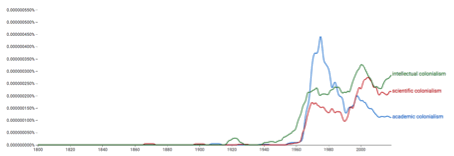
Source: Google
Ngram Viewer (consulted on 8 June 2021)
During the last
decade, Mark Solovey and Hamilton Cravens, along with the Austrian sociologist
Christian Dayé and other scholars, have studied what they call ‘Cold War Social
Science’, namely the interweaving of the geopolitical stakes of the Cold War
with the scientific stakes of the internationalization of social sciences.
The history of
the social sciences is not independent but is part of a complex set of logics
– scientific, political and military among others – that challenge
the apparent separation of the different social spheres. The humanities and the
social sciences, both western and communist, have not remained neutral. On the
western side, they have benefited – and often in an important way –
from public subsidies or from the work of philanthropic foundations such as the
Ford Foundation, the Rockefeller Foundation or the Fulbright Foundation for the
elaboration of research programmes whose objective was not necessarily and
purely motivated by the libido sciendi.
The example of Project Camelot is quite
telling in this respect. This largescale and massively funded project which,
with the declared aim of analyzing Latin American societies and cultures and
under the scientific backing of a large number of American experts or experts
living in the United States at the time, was in fact aimed, from 1964 onwards,
at assessing the risks of a communist revolution in South America. Revealed in
1965 as being more of a political than a scientific project, it was cancelled
in July of the same year. Involved in the denunciation of Project Camelot, the
Norwegian sociologist wrote a paper in 1967 titled ‘Scientific colonialism’
that contributed to the beginning of a collective reflection, especially in the
United States, about the links between science and politics.
This reflection
has gathered all the more momentum since, as Frances Saunders and Tity de Vries
studied it extensively, the role of the CIA in the funding of philanthropic
foundations, intellectual reviews and organizations, was publicly revealed in
1967. Quite paradoxically, even though the consultants to the Camelot project
were overwhelmingly sociologists, political scientists and psychologists,
anthropology is undoubtedly the discipline in which the scientific consequences
have been the most significant.
Although the long history of institutional
relations between anthropology and the American government goes back to the
Second World War, it was after the failure of Camelot that the main calls for
the reinvention of anthropology were made. We can notably mention, among
others, those by Dell Hymes and Kathleen Gough, both relying on the statement
made in 1968 by Kathleen Gough: ‘Anthropology was born of Western imperialism.’
However, as the anthropologist Peter Pels clearly shows, the general trend was
largely a will to move towards a reformulation of the ethical foundations of
the discipline as well as the establishment of deontological codes protecting
the populations studied.
In this respect,
the failure of the Camelot project constituted a ‘turning point’ in the history
of deontological codification in the discipline of anthropology. Voices calling
for a broader ‘decolonisation (sic) of the social sciences’, as Jack Goody put
it in 1969, were still rare. Only in a few cases, such as Gerald Berreman’s
1969 article about India, was there a direct observation of the claims
advocated by scholars from the developing world.
If colonial
India was under British dominance, independent India and its social sciences
not only largely remained under the British yoke but also endured American
epistemic hegemony, especially after the Ford Foundation established an office
in New Delhi in 1952. This does not mean that no reaction to either domination
was ever expressed before. Perhaps one of the best early examples is the
lecture given in 1928 at Hooghly College, University of Calcutta, by the Indian
philosopher Krishnachandra Bhattacharya, in which he takes up the idea of swaraj,
used by Gandhi to describe Indian self-determination, and applies it to the
field of ideas, considering that ‘the hybridisation of ideas brought about by
our education and the impact of Western political, social and economic
institutions of our daily life is one of the most distressing features of our
present situation.’
The 1950s and 1960s represent a fundamental
period for Indian sociology for at least two reasons. On the one hand, the
constitution – under the aegis of the Department of Sociology of Bombay
University headed by G.S. Ghurye – of the Indian Sociological Society in
December 1951 and the founding in 1952 of the journal Sociological Bulletin,
as well as the organization of the All-India Sociological Conferences from 1955
onwards by the Department of Sociology of Lucknow University, provided the
basis for a growing institutionalization of the discipline while the number of
university departments increased and gradually spread to all states of the
country.
On the other
hand, especially following an article written by the French anthropologist
Louis Dumont and the British anthropologist
David F. Pocock in the first volume of Contributions to Indian Sociology,
an important debate arose about
the specificities of an Indian sociology
(or a sociology in India) in contrast with a sociology of India.
This debate contributed to laying some of
the foundations for a larger discussion like the one present in the special
issue of ‘Seminar’ about academic colonialism.
The chronology
shall be taken in close consideration here. In 1967, as recalled by Nicole
Sackley, 26 scholars from the University of New Delhi released a public
statement against ‘U.S. infiltration in our universities’. The very same year,
in his presidential address to the Conference of Indian Sociologists, convened
by the Indian Sociological Society in Bombay (14-16 October 1967), M.N.
Srinivas insisted on the fact that the mission consisting in saving Indian
academics’ freedom to do what they consider worthwhile from the influence of
fund-giving bodies and international ‘cooperative’ research ventures was a problem
that should become a more crucial issue for sociologists than it used to be so
far.
In July 1968, the Indian anthropologist
J.P.S. Uberoi, a professor of sociology and anthropology at the University
of Delhi who had trained at the University of Manchester before obtaining his
PhD at the Australian National University, presented a paper entitled ‘Science
and Swaraj’ at a conference on urgent research in social anthropology held by
the
Indian Institute of Advanced Study (Simla). Without any reference to
Bhattacharya’s conference forty years before, he picked the same Hindi word to
describe an epistemic world of power relations and domination:
‘There is no “world community of science”, unless that phrase be
another name for the national and international science of rich nations.
Scientistic internationalism is a bridge of illusion, a cloak of comfort across
the chasm. The existing system of foreign aid in science, to which the
internationalist notion of collaboration lends credence, in truth upholds the
system of foreign dominance in all matters of scientific and professional life
and organization. It is nothing but the satellite system, with an added
subsidy. It subordinates the national science of the poor to the national and
international science of the rich. It confirms our dependence and helplessness
and will not end them. The reason for these effects is simple and fundamental:
the national and the international systems inherently are synonymous for the
rich but opposites for the poor. This relativism is the iron law of
international collaboration.’
The swaraj counterpart lies in the capacity
to ‘nationalize’ science in order to get released from scientific colonialism:
‘Every swarajist should recognize what are the essential
preconditions, under this system, for the advancement of universal science in
our environment. Until we can concentrate on decolonialization, learn to
nationalize our problems and take our poverty seriously, we shall continue to be
both colonial and unoriginal. A national school, avowed and conscious, can
perhaps add relevance, meaning and potency to our science; continued assent to
the international system cannot.’
The cancellation
of Project Camelot, the revelations about the funding role of the CIA and the
light they brought onto the relationship between some fractions of the American
social sciences (within anthropology, sociology, political science, etc.) knew
an Indian version in the summer of 1968 when it was discovered that the
Himalayan Border Countries Project (HBCP) that had been implemented by the
University of California, Berkeley, since 1967, benefited from a huge grant
from the United States Department of Defence.
The December
1968 issue of ‘Seminar’ is undoubtedly the result of both a specific
international and
Indian context that was not favourable to the United States, and a longer-term
process about the refusal of any lingering economic, geopolitical and epistemic
colonialism. This combination was not specifically Indian. It marks a number of
other counter-hegemonic struggles throughout the world.
The consequences of the Camelot and CIA
scandal are far from being limited to the ‘epistemological revolution’ (i.e.
the challenging of the researcher’s impartiality and objectivity, as well as a
renewed criticism of the notion of value-free research) identified by Solovey.
In particular, this ‘revolution’ is not only visible in some western social
science academic milieux. Indeed, although in other ways, it is also breaking
out throughout the Latin American continent, and not only in Chile as it was
studied by Juan José Navarro. A 1966 article by the Puerto Rican sociologist
Manuel Maldonado-Denis noted that the ideal of a ‘value-free’ (libre de
valores) social science had been replaced in the United States by a
‘scientific-social ideology’.
Moreover, while
the reactions were not necessarily immediate and sometimes not based on the
example of the Camelot project, they were clearly indicative of a near-global
transformation in thinking about the links between social science and policy.
Whereas in core western states the reflection upon the transformation of
anthropology was mostly focused on the epistemological, methodological and
ethical foundations of the discipline, more and more academics in the rest of
the world started challenging the very presence or ‘infiltration’ of western
social scientists on their ‘own’ fieldwork.
While many
criticisms of the foreign presence and its role in the devaluation or
disappearance of endogenous thinking had already been voiced before, they took
a new turn in the second half of the 1960s, and even more precisely from
1967-1968 onwards. They notably started using increasingly similar formulations
without a primary reference being detected: ‘academic colonialism’ of course,
but also ‘scientific colonialism’ (Galtung), ‘intellectual imp-erialism’ as one
can find it denounced by the Malaysian sociologist Syed Hussein Alatas in 1969,
or ‘int-ellectual colonialism’ (colonialism intellectual) pointed out by
the Colombian sociologist Orlando Fals Borda in 1970.
This capacity for naming, whose formative
dimension is essential since it contributes greatly to the very existence of
the cause, is just as effective when it comes to qualifying the ‘exit’ from
this situation by calling for the ‘decolonization’ of the social sciences in
general or of a particular discipline (sociology or anthropology most of the
time). This can be read as early as 1967 in the writings of the Moroccan
sociologist Abdelkébir Khatibi, or in 1971 in a text written by the Mexican
anthropologist Rodolfo Stavenhagen.
This onomastic
networking took place and gained momentum at the same time as the emergence of
the Third World as a global political actor after the Bandoeng Conference and
the gradual establishment of trans-national scholarly networks, generally
sponsored by the UNESCO or by the CODESRIA (Council for the Development of
Social Science Research in Africa), under the direction of Samir Amin, which
allowed for the very real meeting of those who had often crossed paths only
through words.
Considered
through the prism of a global history of counter-hegemonic resistance in the
social sciences, the special issue of ‘Seminar’ on academic colonialism should
be read at the intersection of the different histories we have mentioned and
not only from its political and epistemic value as has often been the case so
far. A better consideration of the historicity of these resistances and their
gradual connection with one another will certainly allow us to better
understand how the absence of social science reflections in non-western
countries does not reflect their non-existence at all, but rather their
invisibility within a largely canonized history.
References
Syed Hussein Alatas, ‘Academic Imperialism’, address delivered before the Historical Society of Singapore, 26 September 1969.
Joseph E. Baker, ‘Provinciality’, College English 6, 1940, pp. 488-494.
Gerald D. Berreman, ‘Academic Colonialism: Not So Innocent Abroad’, The Nation, 10 November 1969, pp. 505-508.
Krishnachandra Bhattacharya, ‘Swaraj in Ideas (1928)’, in Sisirkumar Ghose (ed.), Four Indian Critical Essays: K. C. Bhattacharya, B.N. Seal, Rabindranath Tagore, Sri Aurobindo. Jijnasa, Calcutta, 1977, pp. 13-22.
Christian Dayé, Experts, Social Scientists, and Techniques of Prognosis in Cold War America. Palgrave Macmillan, New York, 2020.
Louis Dumont and David Pocock, ‘For a Sociology of India’, Contributions to Indian Sociology 1, 1957, pp. 7-19.
Orlando Fals Borda, Cienciapropia y colonialismointellectual. Nuestro Tiempo, Mexico, 1970.
Johan Galtung, ‘Scientific Colonialism’, Transition 30, 1967, pp. 10-15.
Harold H. Fisher, ‘Growing Pains of Slavic and East European Area Training’, American Slavic and East European Review 17(3), 1958, pp. 346-350.
Jack Goody, ‘Comparative Sociology and the Decolonization of the Social Sciences’, in Jack Goody, Comparative Studies in Kinship. Routledge and Kegan, London,1969, pp. 1-12.
Kathleen Gough, ‘Anthropology and Imperialism’, Monthly Review 19(11), 1968, pp.12-27.
Wayne H. Holtzman, ‘Cross-Cultural Studies in Psychology’, International Journal of Psychology 3(2), 1968, pp. 83-91.
Dell Hymes (ed.), Reinventing Anthropology. Pantheon Books, New York, 1972.
Abdelkébir Khatibi, Bilan de la sociologie au Maroc. Association pour la recherche en sciences humaines, Rabat, 1967.
Manuel Maldonado-Denis, ‘Sobre el uso y abuso de las cienciassociales: el casodel Proyecto Camelot’, Revista de ciencias sociales 10(4), 1966, pp. 403-416.
National Foundation for Social Sciences: Hearings Before the United States Senate Committee on Government Operations, Subcommittee on Government Research, Ninetieth Congress, First Session, Parts1 to 3. U.S. Government Printing Office, Washington, 1967.
Juan José Navarro, ‘Cold War in Latin America: The Camelot Project (1964-1965) and the Political and Academic Reactions of the Chilean Left’, Contemporary Sociology 10(5), 2011, p. 807-825.
Peter Pels, ‘Professions of Duplexity: A Prehistory of Ethical Codes in Anthropology’, Current Anthropology 40(2), 1999, pp. 101-114.
Karnatur Bhaskara Rao, Candle Against the Wind: An Explosive Novel of University Life in India. Samyukta Karnatak Press, Bangalore, 1963.
Carl M. Rosenquist, ‘Academic Colonialism’, The Southwestern Social Science Quarterly 35(1), 1954, pp. 3-10.
Nicole Sackley, ‘Foundation in the Field: The Ford Foundation New Delhi Office and the Construction of Development Knowledge, 1951-1970’, in John Krige and Helke Rausch (eds.), American Foundations and the Coproduction of World Order in the Twentieth Century. Vandenhoeck & Ruprecht, Göttingen, 2012, pp. 232-60.
Frances S. Saunders, The Cultural Cold War: The CIA and the World of Arts and LettersThe Free Press, New York, 2000.
Mark Solovey, ‘Project Camelot and the 1960s Epistemological Revolution: Rethinking the Politics-Patronage-SocialScience Nexus’, Social Studies of Science31(2), 2001, pp. 171-206.
Mark Solovey and Hamilton Cravens (eds.), Cold War Social Science. Knowledge Production, Liberal Democracy, and Human Nature. Palgrave Macmillan, New York, 2012.
Rodolfo Stavenhagen, ‘Decolonializing Applied Social Sciences’, Human Organization 30(4), 1971, pp. 333-344.
J.P.S. Uberoi, ‘Science and Swaraj’, Contributions to Indian Sociology 2(1), 1968, pp. 119-123.
Tity de Vries, ‘The 1967 Central Intelligence Agency Scandal: Catalyst in a Transforming Relationship between State and People’, The Journal of American History 98(4), 2012, pp.1075-1092.
Kevin A. Yelvington, ‘“A Conference That Didn’t”: African Diaspora Studies and an Episode in Anthropology’s Identity Politics of Representation’, Critique of Anthropology 38(4), 2018, pp. 407-432.